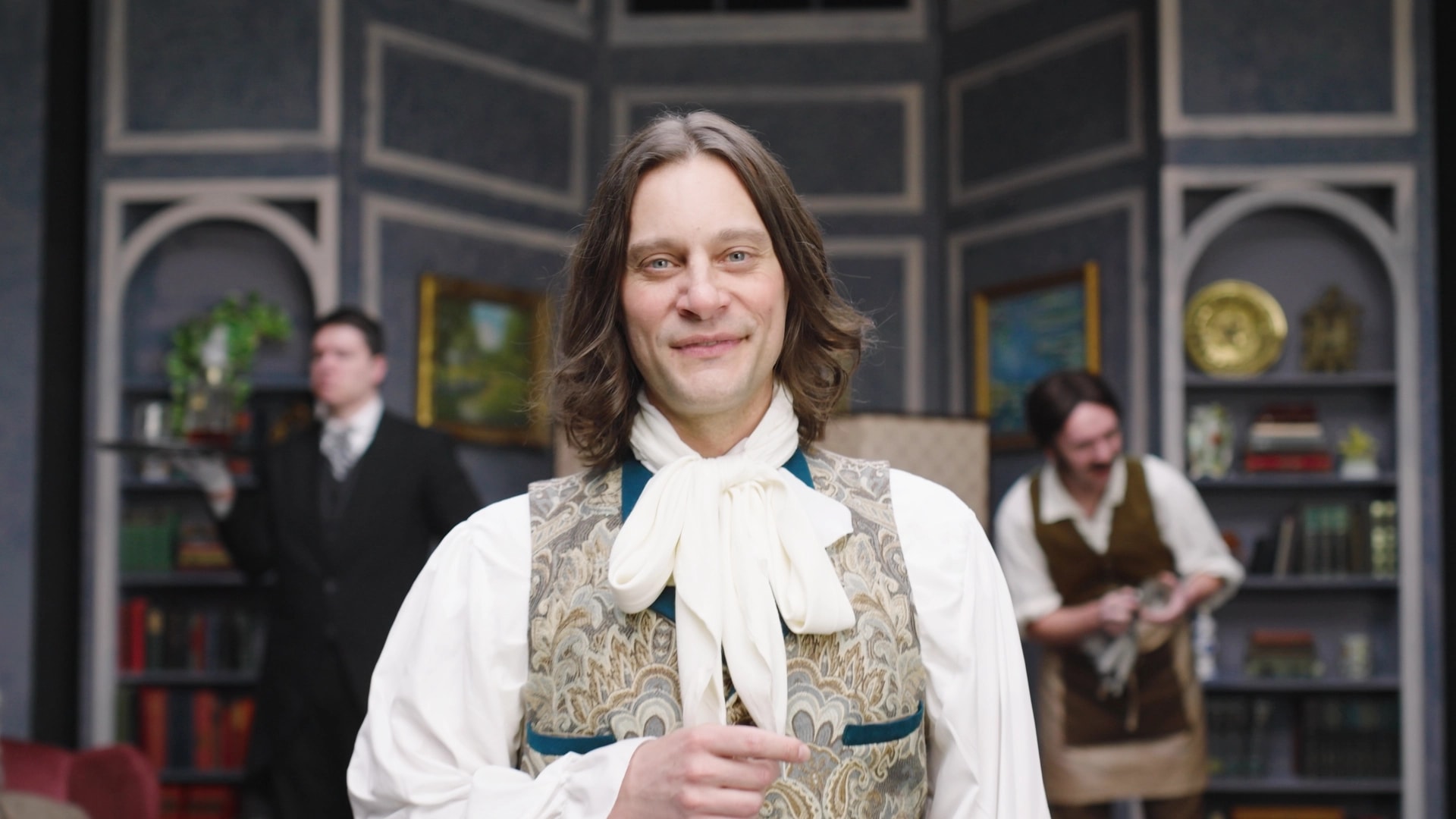
Licensing the Stage: How SALT Built an International Sales Engine and Historical Archive for The Presentation
SALT partnered with creator Brian Gardner to film The Presentation at Grand Valley State University as both a historical archive and a cinematic licensing tool. Our $26,000 two-day model turned a live theatre production into a sales reel that sparked London producer interest in less than 24 hours.
SALT filmed The Presentation for creator Brian Gardner at Grand Valley State University's Linn Maxwell Keller Black Box Theatre, pairing a three-camera live show capture with a second day of stage-level cinematic footage. The result preserved the production as a historical record, built a stronger licensing tool for buyers, and helped generate an international production opportunity in less than 24 hours.
- →We split the job into a live archival day and a cinematic sales-reel day so neither goal had to shrink.
- →Dedicated audience-reaction capture gave future buyers proof that the script landed in a real room.
- →Ronin 4D movement let producers experience the play from onstage proximity instead of back-row distance.
- →The finished package helped open an international licensing conversation in under 24 hours.
Quick Proof
Theatre creators and live productions that need event video production to preserve the work and sell the room.
- Service this proves
- Live theatre capture, documentary storytelling, and licensing video
- Problem SALT solved
- Preserve the play as a historical record while creating a sharper sales tool for licensing conversations.
- Outcome
- London producer interest in less than 24 hours, helping turn the video into an international sales engine.
- What SALT delivered
- A two-day, $26,000 model pairing three-camera live capture with stage-level cinematic footage.
$26,000
Production Budget
2
Shoot Days
3
Live Capture Cameras
<24 Hours
Producer Response
London Deal
Licensing Outcome
The Full Story
The Challenge
Brian Gardner needed two different jobs from one production. He had to preserve The Presentation as a full historical record, but he also needed a sharper sales tool that could help license the play beyond its staging at Grand Valley State University.
That tension matters in theatre. A back-of-house archive can document blocking and dialogue, but it rarely sells atmosphere, pacing, or emotional pull to a producer who has never seen the work in person. If we tried to force one kind of shoot to do everything, both jobs would come out weaker.
The budget had to stay disciplined too. With a $26,000 production cap, every crew role and capture day needed to justify itself.
Our Approach
We split the work across two days so each day could protect a different outcome. That gave the live performance the respect it deserved and gave the licensing reel the freedom to feel cinematic instead of trapped in archival coverage.
Day One: Historical Capture With a Live Audience
The first day focused on documenting the show in front of an audience with a three-camera Blackmagic Pocket 4K setup. We also assigned a dedicated assistant director to capture audience reactions, because laughter, attention, and emotional response are part of the proof when you are pitching a play to future producers.
Day Two: Cinematic Footage Built for Licensing
The second day belonged to the sales reel. Using a gimbal-mounted DJI Ronin 4D 6K on an empty set, we could move onto the stage, work close to the actors, and create the kind of intimate motion a live audience never sees from their seats.
We Coordinated With the Theatre Team, Not Around Them
This only works when film production respects live performance. We worked closely with the stage manager, director, and cast so the cinematic day supported the existing vision instead of fighting it.
The Impact
The final package gave Brian Gardner two tools instead of one compromise. He walked away with a preserved record of the full production and a polished reel that could help buyers picture the play at a higher level.
That second piece moved fast. After Gardner sent the reel to a seasoned London theatre producer, he got a response in less than 24 hours, and the project helped secure an international production path. That is the real business case for this kind of work. Strong video does not just document what happened. It helps future partners see what could happen next.
The project also proves something broader for theatre creators. If you want to license a stage work, you need more than a static archive. You need visual proof that carries scale, tone, and audience response in a way buyers can trust.
Frequently Asked Questions
What was the ROI of filming The Presentation?
The promotional reel helped spark an international production opportunity in London less than 24 hours after Brian Gardner shared it with a veteran producer. That made the film more than documentation. It became a real licensing tool.
Why did SALT film the production over two days?
Because the project had two jobs. Day one protected the live historical record, and day two gave us the freedom to move on stage and build a stronger cinematic reel without blocking a live audience.
What did SALT capture besides the promotional reel?
We also captured the full show with a three-camera setup and gathered real audience reactions during the live performance. That combination gave the creator a preserved record and stronger social proof for future buyers.
What equipment did SALT use to film the play?
We used Blackmagic Pocket 4K cameras for the live show capture and a DJI Ronin 4D 6K for the cinematic stage footage. That mix gave us dependable multi-cam coverage on the performance night and fluid movement on the empty-set day.
Why not rely on a standard back-of-house archive alone?
Because archive footage proves the show existed, but it rarely sells the experience. Licensing conversations move faster when producers can feel the pacing, intimacy, and audience response instead of just studying a static wide shot.
Can SALT build similar licensing reels for other live productions?
Yes. This project shows how we handle theatre, live events, and performance-based storytelling when the footage needs to preserve the original work and help sell the next opportunity.
Where is SALT located?
We are a woman-owned creative video company based in Grand Rapids, Michigan. We make documentary, branded, and commercial work locally, nationally, and internationally.
- →We split the job into a live archival day and a cinematic sales-reel day so neither goal had to shrink.
- →Dedicated audience-reaction capture gave future buyers proof that the script landed in a real room.
- →Ronin 4D movement let producers experience the play from onstage proximity instead of back-row distance.
- →The finished package helped open an international licensing conversation in under 24 hours.
“He loved you guys' video and called less than 24 hours after I sent it to him. Thanks again for the stellar work. I do believe it's been a very important cog in garnering interest in The Presentation.”
Corporate Video Pre-Production Checklist for West Michigan Teams
Use our pre-production checklist to plan interviews, locations, approvals, timelines, and deliverables before your corporate video shoot.
What Should Be in a Video Production Brief?
A strong video production brief gives the creative team the audience, goal, message, guardrails, and delivery plan they need to do useful work.